










Brookhaven Scientists Peer Into the Universe’s Earliest Matter With sPHENIX Detector


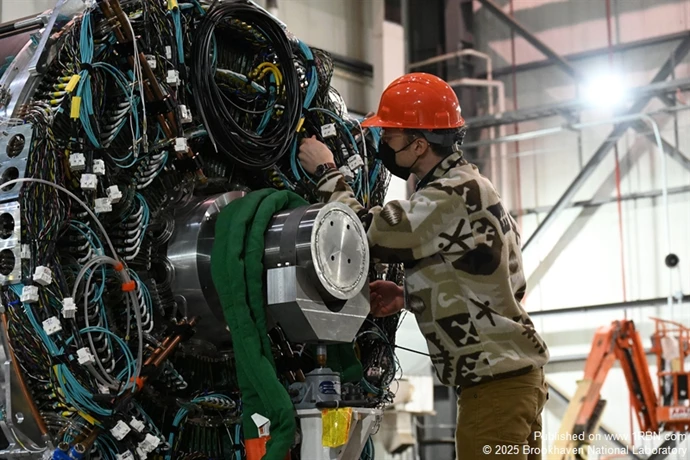
Photo by Brookhaven National LaboratoryA researcher works on the time projection chamber, a key component of the sPHENIX detector at RHIC, which tracks charged particles from high-energy nuclear collisions to study quark-gluon plasma.
December 18, 2025 | Brookhaven National Laboratory Physicists at Brookhaven National Laboratory are using a powerful instrument known as a time projection chamber to unlock new insights into the fundamental structure of matter at the Relativistic Heavy Ion Collider (RHIC).
Despite its name, the time projection chamber has nothing to do with time travel. Instead, it serves as a gas-filled tracking device at the heart of the sPHENIX detector, precisely measuring the momentum of charged particles created when atomic nuclei collide at nearly the speed of light.
These measurements allow scientists to study the quark-gluon plasma, an extremely hot, dense state of matter that existed microseconds after the Big Bang. By reconstructing the paths of particles emerging from RHIC’s collisions, researchers can better understand how matter’s most basic building blocks behaved in the early universe.
The time projection chamber is one of several advanced detector components enabling sPHENIX physicists to explore conditions that no longer exist naturally, helping bridge the gap between modern physics experiments and the origins of the cosmos.
No information from the author.