










Automated Delivery Robot disrupts Jersey City Fireground Activity
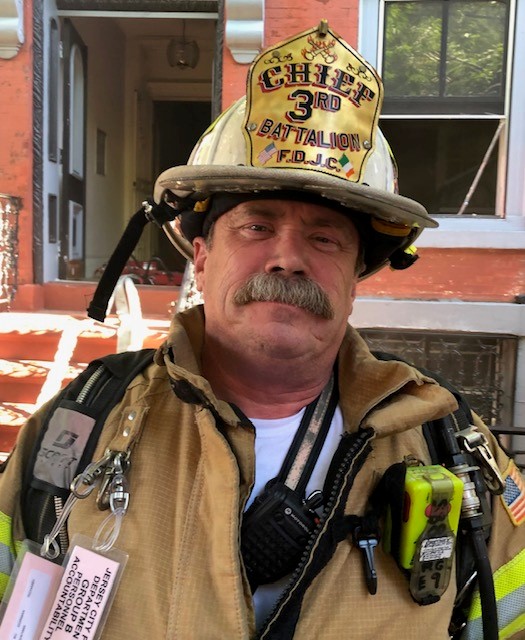


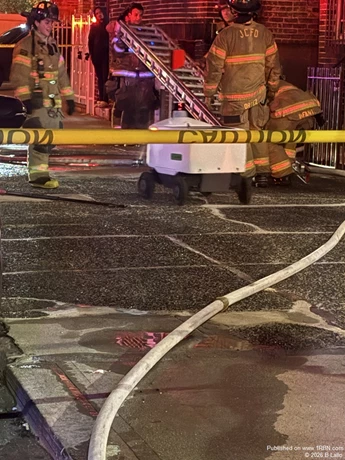
Photo by B LalloRobot bypasses perimeter tape to cross into fireground
Delivery Robots are becoming more prevalent in all sections Jersey City. If you haven’t seen them, do a google search or go to “ https://www.AVRide.ai ”. That website is very informative of their mission, the robot capability and safety features. The FDJC is in contact with the NJ Local AVRide Logistics Manager, and we working to develop and deliver a Fire Department Specific Orientation. Keep in mind there are other robot type and styles under different operating systems. There are robot that are truly remotely operated by humans in a control room.
There are cities in the US that are being used by AVRide ,in a pilot program, such as Austin since November 2024, Dallas since December 2025, and recently Jersey City in February 2025. The AVRide website has statistics and outline their success. However, we are in a transition period. These robots are out and about and both the robot delivery industry and the local public safety officials are learning how to co-exist. These robots are going to increase obstacles that emergency response personnel have to safely navigate. As far as having a collision with such a vehicle, I am not aware of a procedure. Does this unit even qualify as a “vehicle” according to NJ Statutes? The answer may surprise you. The robot size and speed restrictions at less than 5-7 mph actually qualify it as a pedestrian. Vehicle or not, either way, it makes sense that if a fire apparatus is damaged by any type of collision it will cause a delay in response and must be dealt with and appropriately reported.
During emergency responses, these robots that are crossing streets, may not yield to emergency traffic, since our apparatus doesn’t enter their “field of view” until it is committed in the crosswalk. If they do, their reaction is very slow, as the navigation programming is deciding its best option. The “field of view” is lower. The sensors of the robot a fixed and are at the robot’s height. While the sensory field expands outwards and returns information much like sonar, its “periphery” is limited a different intervals.
Recently a delivery robot entered an active fire operation in Jersey City, NJ. At first glance, it looks innocent and harmless, even surprising as we are not really accustomed to these vehicles on sidewalks as they make their deliveries.
For a review and the analysis of the real and potential implications on Firefighter Safety and Fireground activity.
In this incident, caution tape was deployed at a chest height level. Firefighters were working to take down a 35 ft ground ladder and there was a 1 ¾ working. As Command and safety officers are looking up to ensure the tip of the ladder is clearing the electrical service lines to avoid contact, we are redirected by a firefighter to the ground. We immediately see this robot and it is actively seeking passage through our fireground. Now the ladder is being lowered, we inform the officer and crew to stop all movement trying assess. This is not an ordinary event. We are trained to stop activity when unusual occurrence happen. This was one of those moments. As the ladder was already resting on the ground, all members watched this robot. It was searching for a path without obstacles. We moved the ladder back to the truck company it came from. We moved the handline from the sidewalk, and the robot was free to navigate through our area. Remember that “field of view”? The robots Logistics Manager states that it would have recognized a traffic cone, appropriate to its “View” and would not have crossed into the hazard area.
Take into consideration the Major Safety Concerns presented by these robots.
Fire Apparatus & Operational Interference
As briefly mentioned , Delivery robots could block or slow the movement of fire engines, trucks, ambulances, or other emergency vehicles. The apparatus placement due to delays could be greatly impacted.
Robots could obstruct handline placement and advancement, including LDH supply lines, as well as disrupt aerial ladder placement and, as shown here, ground ladder deployment.
Even small obstacles and distraction can disrupt a fireground’s carefully controlled rhythm and tempo.
Hazards to Firefighter’s Safety
Robots wandering into the incident perimeter could trip personnel carrying heavy gear to perform our assignment or disrupt our ability to remove a victim and present them to EMS because EMS is also navigating around an obstacle.
They could obstruct ingress/ egress routes for fleeing occupants and victims, which are the firefighters pathway for our initial operations as well. Now add the dynamic od panic, confusion, low/no light, and smoke to create additional hazards.
As Firefighters, we often operate with limited visibility and try to maximize our movement in critical times. While we are able to negotiate many obstacle , adding unexpected moving devices enhances our risk and danger. A robot approaching a panicked evacuee could worsen injuries or confusion. Emergency scenes often include: Police perimeters, Hazmat zones, Collapse zones, Falling debris zones, Utility hazards (such as downed wires) and our list is long. No matter the situation, emergency or not, Robots lack the ability to evaluate these dynamic, life-threatening conditions.
Robot Becoming a part of the incident
Fire hoses of many diameter and function are being deployed based on the location and extent of the fire. They operate at high pressure. A hose line or a hose stream can strike the robot and could send it tumbling. In this case it must be addressed as piece that can be moved, or evaluated if it is compromised.
If left in front of a building long enough, could high radiant heat or water damage batteries, electronics, or other components?
Complications such as electrical hazards, Battery fires (lithium-ion thermal runaway) and Toxic smoke if the device melts or burns
Loss of orientation or navigational control is also a problem. Robots are usually autonomous with limited situational navigational sensing.
Although there is a web link or WiFi link associated with a human navigation override from a remote workstation, the human override is also time consuming as they attempt to investigate HOW and WHY did the robot find itself in trouble. Some, more advanced, are programmed to respond to barriers and even some hand signals by humans. But these response are if the robot senses them in their sensing field. However they do Ignore police/fire barriers, misread hoses, or firefighters as navigable obstacles, so they try to reroute through unsafe or restricted areas. In our case, the robot just kept making “K” turns in an attempt to scan and determine an exit pathway.
This undermines incident command and situational awareness as the fireground must find safe solution around our intruder’s presence.
Their presence may have an impact on Fire scene and Crime scene or impact Evidence Preservation. Once our operation is complete, a robot that rolls over the scene may compromise Burn patterns, Debris patterns, Footprints, Blood or fluid patterns, gun casings, and other clues. Any investigator will certainly explain how this robot could destroy evidence or disrupt investigative procedures. Even the Jersey City Police have law enforcement and crime scene investigation concerns yet to be addressed.
Liability Issues
The possibility of a robot damaging equipment, causing injury to a civilian and/or a firefighter, delays and disrupting operational patterns and sequences exists. As these conditions present, they will create a liability as it introduces legal, financial, and operational complications for both the delivery company and the fire department.
Public Confusion
Seeing a delivery robot entering an emergency zone can undermine public trust in scene control, distract onlookers or social media attention from safety instructions. The worse case scenario this encourage others (drivers, pedestrians) to ignore barricades. The fireground is already a complex environment and any introduction of additional distraction and interference has an impact on safety and health of our firefighters and the people requiring assistance.
Resource Diversion
The FDJC has been in direct contact with the AVRide Logistics Manager for our region and we are developing an Orientation for Emergency First Responder and the operations and systems associated with the robots. We will prepare for emergnecies associated with these vehicle.
If a robot breaks down, catches fire, or becomes stuck, Firefighters may need to move it or disable it. This ios an added demand on the fireground decision making diverts personnel from life-safety tasks.
Summary
Any autonomous delivery robot entering an active fire scene poses a significant safety risk—to firefighters, civilians, equipment, and the incident itself. These environments require absolute control, fast movement, and clear pathways. Autonomous systems simply do not have the real-time judgment to safely navigate a dynamic emergency zone.
As my research and our emergency procedures expand, so will updated information be furnished.
Quick Reference Guide
If a robot enters a fire scene:
1. Maintain life-safety operations and priorities
2. Notify Incident Commander
3. Use barrier/stop gesture
4. Immobilize safely if needed
5. Check for battery hazards
6. Move out of operational zone
7. Document & notify authorities
Battalion Chief Richard D Gorman
Jersey City Fire Department
Richard D Gorman is a 33 year member of the fire service and is a Battalion Chief with the Jersey City (NJ) Fire Department current assigned to the city’s 3rd Battalion Grp B. He is previously a 13 year member with the NJ-TF 1 USAR as a Haz Mat Manager. Other positions within Jersey City include Haz Mat Coordinator, and Deputy Director of OEM/HS and the FD Liaison. He is a NJDFS Instructor Level 2/DGI and Haz Mat CBRNE Specialist for more than 25 years. He is also the current Director of the Toms River Fire Training Center.
Richard D Gorman is a 33 year member of the fire service and is a Battalion Chief with the Jersey City (NJ) Fire Department current assigned to the city’s 3rd Battalion Grp B. He is previously a 13 year member with the NJ-TF 1 USAR as a Haz Mat Manager. Other positions within Jersey City include Haz Mat Coordinator, and Deputy Director of OEM/HS and the FD Liaison. He is a NJDFS Instructor Level 2/DGI and Haz Mat CBRNE Specialist for more than 25 years. He is also the current Director of the Toms River Fire Training Center.