










Rensselaer Sheriff’s Office in Crisis Over Union Charges



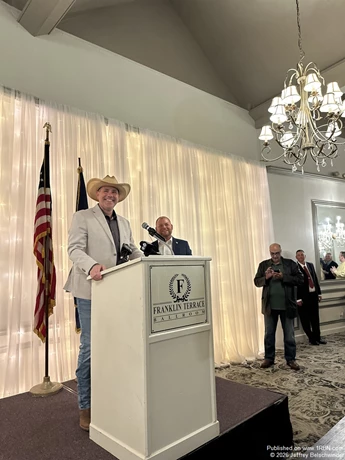
Photo by Jeffrey BelschwinderPhoto of Rensselaer County Sheriff Kyle Bourgault
Troy, N.Y., A blistering, detailed letter submitted to the Rensselaer County Legislature is placing Sheriff Kyle Bourgault and his command staff at the center of a growing public safety controversy, with union officials outlining what they describe as a systemic breakdown inside the Rensselaer County Sheriff’s Office marked by retaliation, arbitrary decision-making, collapsing morale, and the steady loss of experienced personnel.
The letter, authored by the United Public Service Employees Union’s Coalition of Public Safety Division on behalf of the Rensselaer County Deputy Sheriff’s PBA, warns that conditions inside the agency are not only unacceptable from an employment standpoint, but have reached a level that threatens the integrity, effectiveness, and operational readiness of law enforcement across the county. Union leadership states that since affiliating with the PBA in December 2025, they have observed a consistent pattern of disparate treatment and retaliatory actions directed at union leadership and employees who assert their contractual rights, describing the conduct as systemic rather than isolated.
At the heart of the union’s charges is what they describe as the rapid and unprecedented dismantling of the Sheriff’s Office Investigations Unit. According to the letter, many of the agency’s most experienced investigators have either been forced out, demoted without justification, or have resigned entirely, an alarming trend in a division typically viewed as the pinnacle of a deputy’s career. The voluntary departure of multiple successful investigators, the union argues, is a clear indicator that morale has deteriorated to a critical level. At the same time, the agency’s Emergency Services Unit has also suffered losses, with multiple members resigning in a short period, further highlighting what the union describes as an internal breakdown affecting even the most specialized teams.
The situation within the Emergency Services Unit has now reached what sources describe as a critical operational failure point. Due to severe manpower shortages, the unit is no longer capable of functioning at full operational capacity, raising serious concerns about the county’s ability to handle high-risk incidents. As a result, Rensselaer County would have to rely on outside agencies for specialized response, including the City of Troy’s Emergency Response Team, the Tri-County Special Services Team based out of East Greenbush, and the New York State Police Special Operations Response Team. This shift represents a significant change in how emergency incidents may be handled moving forward, increasing dependence on mutual aid and potentially impacting response times and coordination during critical events.
The document lays out a series of specific incidents that, taken together, paint a picture of leadership instability and questionable decision-making. Among them is the denial of a union leave request submitted by the PBA president, a key leadership figure within the organization, to attend a UPSEU-sponsored seminar, something the union says had historically been approved under longstanding practice. The decision was justified by classifying the request as “training,” a characterization the union disputes, pointing to prior approvals under provisions for conferences and meetings, including as recently as March 2026.
In another incident, a senior union official with a 17-year career, who also held a leadership role within the PBA, was ordered into what was described as a “supervisory review” without prior notice of the subject matter. When she invoked her right to union representation, she was reportedly told that whether the meeting was disciplinary would depend on her responses, an approach the union characterizes as coercive and outside standard practice.
Concerns over transparency and honesty within leadership are also highlighted. During a so-called “hats off” meeting, typically intended to allow open discussion without fear of retaliation, a concern was raised about the anticipated hiring of a Chief Deputy, which was reportedly denied by Undersheriff Michael Dinardo. Weeks later, that exact position was filled, raising questions about candor and internal communication within the command structure.
The union further details operational decisions that it claims have had direct and damaging impacts on deputies’ lives. Investigators’ schedules were unilaterally changed from traditional daytime hours to overnight shifts, disregarding seniority and long-standing practices. The change created hardship for families and ultimately led to resignations, only for those positions to later be reassigned back to daytime hours, undermining the stated justification of operational necessity.
Additional incidents outlined in the letter include the reversal of an already approved and posted schedule swap without explanation, a decision that was later attributed to “higher authority,” suggesting interference inconsistent with normal departmental practices. The union also describes a February 2026 meeting involving an investigator that escalated into what it calls an unanticipated and confrontational setting, where criticism extended beyond job performance to personal appearance, including directives about hair color despite compliance with existing policy.
Within weeks of that meeting, an investigator, who was also associated with union leadership activity, was demoted to patrol deputy with a reported $2,500 pay loss, a move justified by what was described as a “department-wide analysis.” According to the union, no documentation supporting that analysis could be produced when requested, raising serious questions about the legitimacy of the action. Despite subsequent vacancies in the Investigations Unit, the investigator has not been reinstated.
The letter also alleges instances of employees, including individuals holding union leadership roles, being pressured to sign documentation outside their authority, including a case where an investigator initially refused to sign paperwork designated for a committee member before ultimately doing so under what the union describes as aggressive questioning and pressure.
Disciplinary practices are another major focus. The union cites a case in which an investigator accepted a 30-day suspension, only to return and be issued a new “Deputy Sheriff” badge and effectively demoted without prior notice, agreement, or due process. The matter, according to the letter, is expected to be litigated.
Beyond personnel decisions, the union raises broader concerns about double standards within the agency. It alleges that command staff have been observed violating professional standards, such as dress code expectations, while line staff are disciplined for similar conduct. It also claims that county resources, including vehicles, have been used by leadership for personal or family purposes, behavior that deputies say would typically result in discipline if committed by rank-and-file members.
Facility access and workplace policies are also described as being applied unevenly, with line staff restricted from certain areas while administrative personnel retain access, and previously available shared spaces being locked or repurposed without explanation. The union argues that these actions contribute to an increasingly inequitable and restrictive work environment.
The individuals at the center of many of the incidents outlined in the letter are not random employees, but members of union leadership, a detail that significantly raises the stakes of the allegations. According to the union, multiple actions described throughout the document involve officials who held leadership roles within the PBA, including those responsible for representing deputies in labor matters. The concentration of disciplinary actions, schedule changes, denials of leave, and administrative scrutiny involving these individuals has led to growing concern that the actions may not be isolated personnel decisions, but part of a broader pattern affecting those in leadership positions.
Beyond internal workplace concerns, the pattern outlined in the letter is now raising broader questions about potential labor rights implications. Actions described by the union, particularly those involving discipline, reassignment, or scrutiny of individuals in leadership roles, may intersect with protections afforded under collective bargaining agreements and applicable labor laws.
Taken together, the union describes a leadership culture defined by inconsistency, unequal treatment, and eroded trust throughout the agency. The result, they say, is a workforce that is discouraged, overburdened, and actively seeking employment elsewhere.
Despite what the union describes as repeated attempts to address these concerns internally, leadership has allegedly failed to take corrective action, prompting the formal appeal to the Rensselaer County Legislature for oversight and accountability.
The fallout from this explosive release is expected to extend beyond the Sheriff’s Office, with potential consequences that could directly impact taxpayers across Rensselaer County. According to sources familiar with the situation and union concerns outlined in the letter, multiple lawsuits are anticipated in the near future, with projected exposure that could exceed $20 million if litigation moves forward. While those figures have not yet been confirmed in court, the scale of the claims being discussed has already raised alarm about the potential financial burden on county residents.
If legal action proceeds, county leadership may face pressure to resolve claims quickly in order to limit long-term costs. Attention is now turning toward County Executive Steve McLaughlin, who would likely play a central role in any settlement discussions should lawsuits be filed.
At the same time, the political impact is beginning to take shape. The controversy is emerging as a potential flashpoint in upcoming elections, where dissatisfaction surrounding these issues could influence voter sentiment.
If the concerns outlined in the letter are not addressed swiftly and decisively, political observers say the situation could reshape the county’s leadership landscape. With challengers expected to seize on the controversy, there is growing speculation that the issue could play a decisive role at the ballot box, potentially shifting control of key positions depending on how voters respond.
As of now, Sheriff Kyle Bourgault has not issued a public response to the charges. With the matter now formally before county lawmakers, pressure is mounting for answers and for action.
However, in a public statement, Sheriff Kyle Bourgault said the agency remains committed to working productively through collective bargaining to resolve issues involving what he described as “a handful of individuals.”
“At the same time, we are fully committed to improving accountability in the department, just as we are fully committed to ensuring the health, safety, and quality of life of everyone who lives and works in Rensselaer County,” Bourgault said.
Sheriff Kyle Bourgault stated this involves “a handful of individuals.”
Let’s be clear about what that actually means.
For the union to issue a letter to the Legislature, it requires a formal vote by the membership, and that vote must pass by majority. So while it may be true that a “handful” of individuals have been singled out or targeted, it is not accurate to suggest this concern is limited to just a few.
The reality is: the majority of the union body voted to move forward with that letter.
That’s not a handful…that’s a clear message.
Framing it otherwise minimizes the broader concerns shared across the membership and distracts from the real issues at hand. The focus shouldn’t be on narrowing the scope of who’s speaking up, but on addressing why so many felt compelled to do so in the first place. Stated the Rensselaer County Deputy Sheriffs PBA